top of page

Resource Center
Migrating a Kubernetes Application From Google GKE to Oracle OKE
RackWare SWIFT Demo RackWare SWIFT is a converged disaster recovery, backup, and migration solution that seamlessly moves applications from one container platform to any other, across Oracle Cloud, Google Kubernetes Engine, IBM OpenShift, Azure Kubernetes Service, and Amazon Web Services. In this demo, a WordPress website deployed on a GKE cluster is migrated to an Oracle Kubernetes Engine (OKE) cluster. What's demonstrated: The discovery phase, where RackWare SWIFT collects
Multi-Cluster OKE Disaster Recovery Across Oracle Regions With RackWare SWIFT
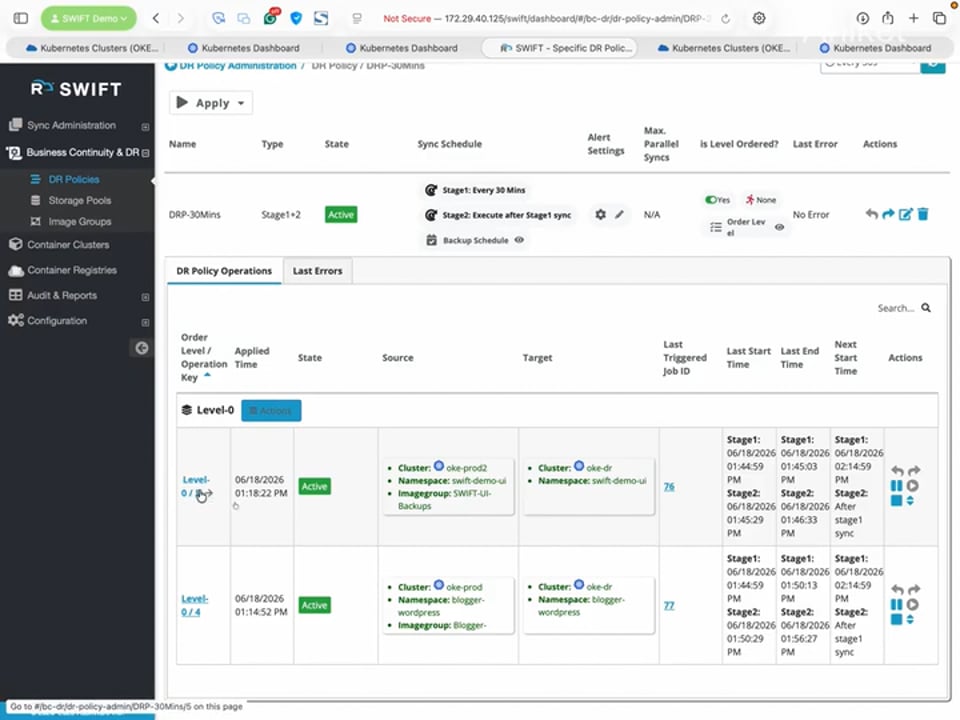
A demonstration of setting up disaster recovery across two Oracle regions with RackWare SWIFT, consolidating two production OKE clusters in US East into a single DR cluster in Phoenix. The clusters sit in one tenancy, though the same steps apply across separate tenancies, and the demo covers a stateful WordPress and MariaDB application alongside a stateless nginx application. What's demonstrated: Reviewing both source clusters through Kubernetes dashboards deployed for the pu


Sovereign AI Mobility for Containerized Workloads
Move AI applications and their state across Kubernetes and OpenShift environments AI applications need the freedom to move when data residency requirements, provider terms, or capacity needs change. For a private knowledge assistant or an AI agent, changing location also means preserving the business data and application state that make it useful. RackWare SWIFT gives enterprises a repeatable way to move containerized AI services into infrastructure they choose and retain the

A Conversation With RackWare's CTO on Filesystem-Level Replication
Why workload mobility has become a standing requirement, how the main replication approaches compare, and what changes for organizations that build migration and DR on a filesystem-level foundation.


Why DR Testing Fails and What Rehearsable Recovery Requires
Most organizations with DR have documented RPOs and RTOs, a replication tool, and a test on the calendar. Far fewer could fail over today and prove every workload would recover within its RTO. The reason is architectural: testing DR is itself a high-risk event, so most teams do it once or twice a year. Here is where legacy DR testing breaks down and what rehearsable, repeatable, and reversible recovery requires: platform-independent replication, isolated test failovers, and a


Gaining Confidence in Your Disaster Recovery Runbook
Most organizations understand the importance of having a disaster recovery (DR) plan. They establish recovery time objectives (RTOs), recovery point objectives (RPOs), replicate critical workloads, and periodically test their ability to recover servers and applications.


Why Kubernetes Applications Need Backup and Disaster Recovery
Imagine a retail platform team finishing a routine release before a weekend promotion. The pods are running. Traffic is flowing. Then support reports that products are disappearing from customers’ saved shopping lists. The team rolls back the application. The faulty code stops running, but the missing records do not return. The database replica has faithfully copied the deletions. Kubernetes has kept the service available while the application has been losing data. Kubernetes
Tanzu to Nutanix NKP Disaster Recovery with RackWare SWIFT: Delta Replication, Failover and Fallback
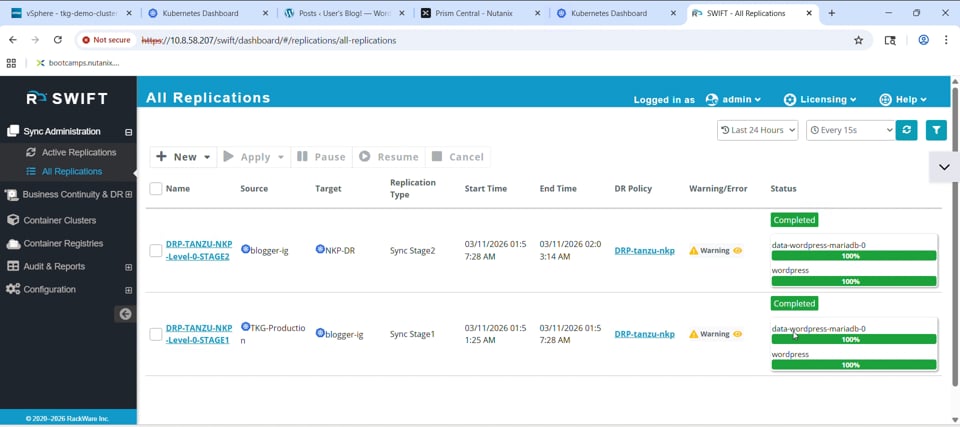
This demo picks up after an initial Stage 1 plus Stage 2 sync between a VMware Tanzu source cluster and a Nutanix Kubernetes Platform (NKP) DR cluster, showing RackWare SWIFT's ongoing DR workflow in action. It covers a delta-only resync triggered automatically by the DR policy after new data is added on the source, verification of the replicated changes on the NKP target, a failover test to the DR cluster, fallback to restore the original Tanzu environment, and local backup
GKE to Nutanix NKP Disaster Recovery with RackWare SWIFT
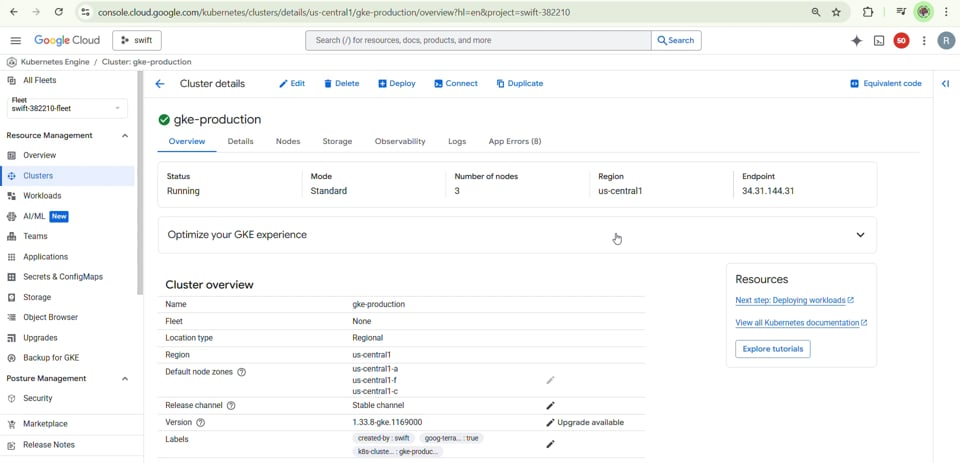
Watch RackWare SWIFT configure disaster recovery replication for a WordPress application running on Google Kubernetes Engine (GKE), protecting it to a Nutanix Kubernetes Platform (NKP) DR cluster. This demo covers adding GKE as a source cluster and NKP as the DR target, storage pool setup for staged sync, replication ordering levels, and automatic storage class conversion from GKE's standard storage to Nutanix volumes. It also shows the full DR policy lifecycle in action: Sta
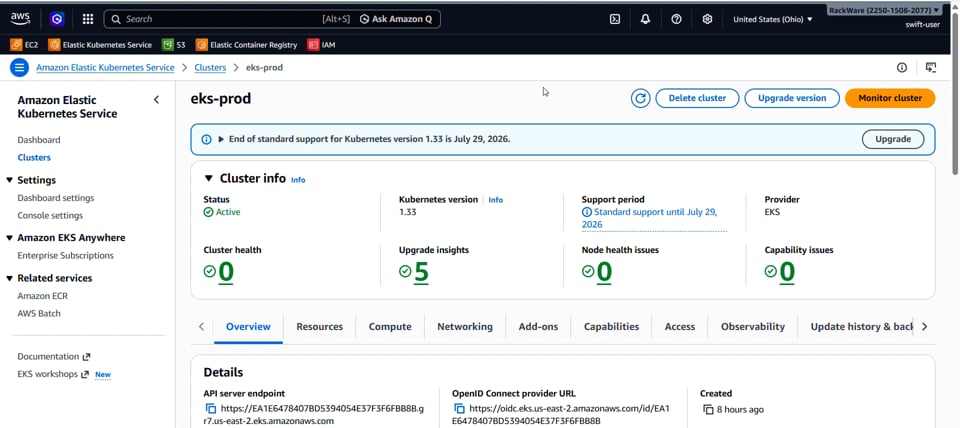
EKS to Nutanix NKP Disaster Recovery with RackWare SWIFT
Watch RackWare SWIFT configure disaster recovery replication for a WordPress application running on Amazon EKS, protecting it to a Nutanix Kubernetes Platform (NKP) DR cluster. This demo covers adding EKS as a source cluster and NKP as the DR target, storage pool setup for staged sync, replication ordering levels, and automatic storage class conversion from Amazon EBS to Nutanix volumes. It also shows the full DR policy lifecycle in action: Stage 1 plus Stage 2 sync execution
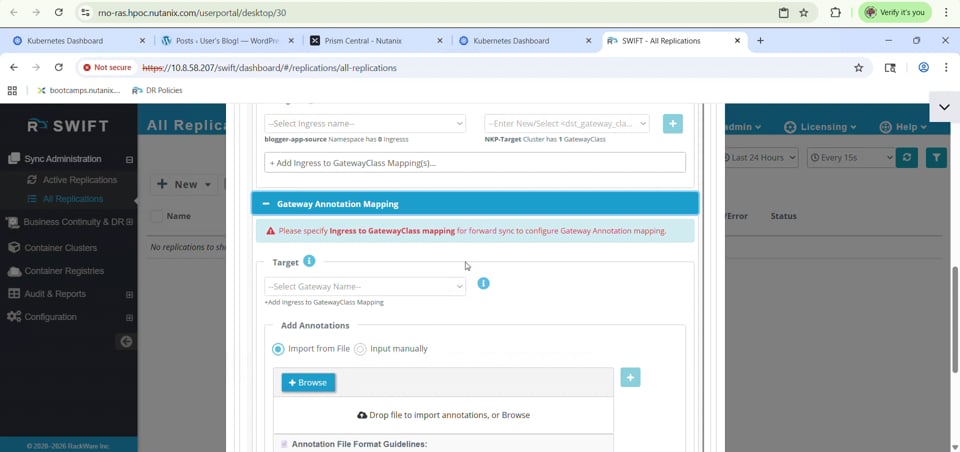
RackWare SWIFT Kubernetes Migration: GKE to Nutanix Kubernetes Platform (NKP)
Watch RackWare SWIFT migrate an application (WordPress) from Google Kubernetes Engine (GKE) to Nutanix Kubernetes Platform (NKP) live, with zero storage staging. This demo covers passthrough sync, automatic storage class conversion, delta-based DR replication, and a full failover test. See how SWIFT syncs a running Kubernetes app between clusters without modifying source objects, replicates only changed data on a schedule, and fails the application over to a new environment i
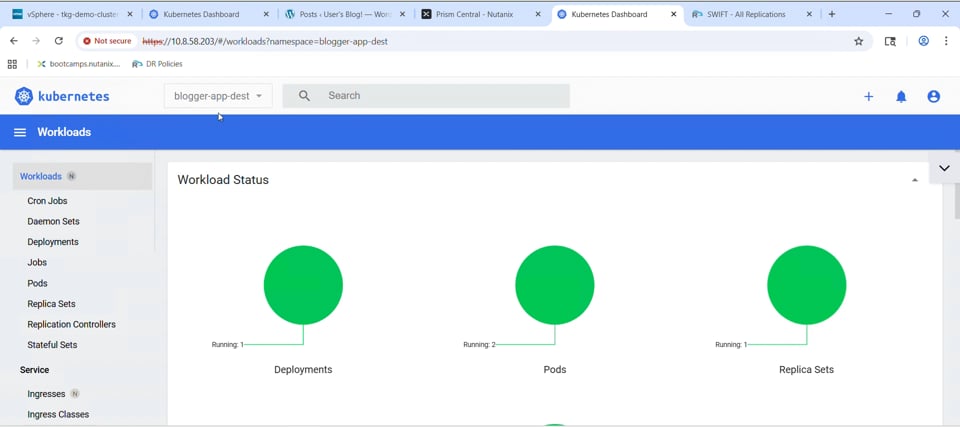
RackWare SWIFT Kubernetes Migration: VMWare Tanzu to Nutanix Kubernetes Platform (NKP)
Watch RackWare SWIFT migrate an application from VMware Tanzu Kubernetes Grid (TKG) to Nutanix Kubernetes Platform (NKP) live, with zero storage staging. This demo covers passthrough sync, automatic storage class conversion, delta-based DR replication, and a full failover test. See how SWIFT syncs a running Kubernetes app between clusters without modifying source objects, replicates only changed data on a schedule, and fails the application over to a new environment in minute
bottom of page