
Why Kubernetes Applications Need Backup and Disaster Recovery
Imagine a retail platform team finishing a routine release before a weekend promotion. The pods are running. Traffic is flowing. Then support reports that products are disappearing from customers’ saved shopping lists.
The team rolls back the application. The faulty code stops running, but the missing records do not return. The database replica has faithfully copied the deletions. Kubernetes has kept the service available while the application has been losing data.
Kubernetes is often assumed to be inherently resilient, because self-healing pods, replica sets, and declarative configuration make applications appear protected by design. Those capabilities provide high availability within a cluster, but they do not recover persistent data, restore a lost cluster, or roll back corruption, accidental deletion, or ransomware. As stateful workloads such as databases and message queues become standard on Kubernetes, the gap between high availability and true backup and disaster recovery has become a critical operational risk.
This is why Kubernetes applications need backup and disaster recovery (DR), even when the cluster is doing its job. With RackWare SWIFT, teams can protect application objects and persistent data, retain recovery points, and prepare to restore into another environment. The need can start with an everyday mistake, well before a data center goes dark.
What the deployment could not undo
Containers are replaceable. The business state around them often is not. A deployment definition describes how an application should run; it does not contain the shopping lists, uploaded files, or transactions created since deployment. Recreating the pods brings back the same application against the same damaged data.
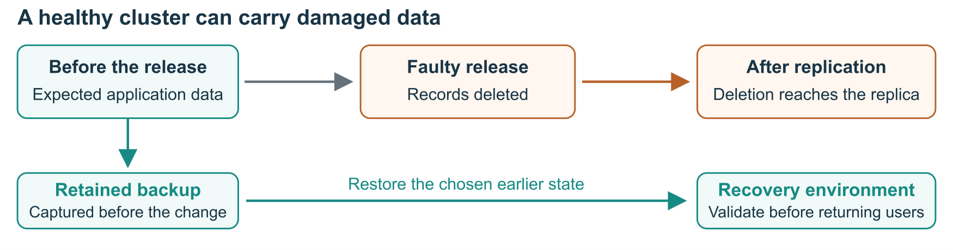
High availability, backup, and DR solve different problems. Availability keeps services running through certain failures. Backup preserves earlier states. DR brings the application back into service when its usual environment cannot support it. Our retail team needs both a way back to good data and a place where the service can run.
Give the application a recovery point
In the review that follows, the team asks what it would take to bring the shopping experience back. The answer includes the application’s Kubernetes objects, persistent volumes, and required dependencies. Restoring those pieces together would spare the team from having to reconstruct the application around a recovered database.
SWIFT discovers Kubernetes and OpenShift resources and captures selected application objects and supported persistent-volume data. Policies schedule protection and retain backups in local storage pools, cloud object storage, or both. Teams can select a retained backup and restore its data and objects to a target cluster.

For this incident, the team would choose a backup from before the faulty release and restore it into a prepared recovery environment. They would verify the shopping lists, use a compatible application version, and account for legitimate changes made after that backup. Choosing the right recovery point is a business decision as well as a technical one.
The team also plans how to capture consistent database state. SWIFT supports scripts before and after synchronization for application-specific actions. The application owners define and test those steps, and arrange the external services, credentials, and network access the recovered application will need.
The next release feels different
For the next release, the team can take a backup before the change and rehearse restoring it. A restored copy can also support upgrade testing in a separate environment, with the team handling isolation and sensitive data. That gives developers a way to test changes against realistic application state and know how they would recover.
It also protects work the business has already paid for. A search index or recommendation dataset might be reproducible, yet rebuilding it can consume compute, engineering time, and hours of customer waiting. The useful comparison is the time and cost to restore versus the time and cost to recreate.
Rehearse the day the cluster is unavailable
At the next rehearsal, the team asks a harder question: if the original cluster disappeared, could the application serve customers from another environment? SWIFT supports DR drills, failover, and fallback workflows. In a prepared test environment, the team can check a customer journey, verify the data, test new writes, and measure recovery time and how recent the recovered data is.
That rehearsal can reveal a missing dependency or a storage mapping that needs attention. SWIFT supports replication and recovery across supported clouds and Kubernetes/OpenShift platforms, so the same preparation can help a planned move. Target compatibility still matters, but the business gains a practical option to change environments.
Make recovery part of the release plan
The retailer’s lesson starts with a routine deployment. A trustworthy way back makes it easier to change the application, preserve valuable work, and prepare for a move. Start with one service that matters: protect its data and objects with SWIFT, restore a chosen backup, and test what a customer actually needs to do.
Request a RackWare SWIFT demo to explore backup and DR for your Kubernetes or OpenShift applications.
Aniket H. Kulkarni is Vice President of Engineering at RackWare, focused on Kubernetes application mobility, backup, and disaster recovery.
Comments