
VMware Exits as a Catalyst for Modernization
Executive Summary
The VMware ecosystem is undergoing one of the most disruptive shifts in its history. Following Broadcom’s acquisition, long‑standing licensing models have been dismantled, perpetual licenses eliminated, and formerly modular capabilities bundled into premium subscription tiers. For many enterprises this has translated into sudden and severe cost increases, often several times higher than prior spend, combined with reduced flexibility and long‑term uncertainty.
As a result, organizations are no longer asking whether they should exit VMware, but how quickly they can do so without introducing risk. At the same time, this moment presents a rare opportunity: to not only migrate away from VMware, but to modernize infrastructure, strengthen resilience, and adopt a more flexible hybrid or multi‑cloud operating model.
This guide provides a practical, technically grounded framework for IT leaders and infrastructure teams navigating that transition. It explains the real challenges of leaving VMware, and how RackWare enables a clean exit while laying the foundation for modernization.
Why Enterprises Are Leaving VMware
For years, VMware was viewed as a stable, predictable foundation for enterprise virtualization. That assumption has changed. Broadcom’s acquisition fundamentally altered VMware’s commercial and strategic posture, introducing uncertainty at both the financial and operational levels.
Licensing has become the most immediate pressure point. The shift to core‑based subscriptions has removed cost predictability and eliminated the safety net of perpetual licenses. Capabilities that were once selectively licensed are now locked into expensive bundles, forcing customers to pay for functionality they may not need. In many environments, these changes have resulted in licensing costs increasing by multiples rather than percentages.
Beyond cost, enterprises are also reassessing VMware in the context of broader IT strategy. Cloud adoption, application modernization, and hybrid operating models are now mainstream objectives. VMware’s evolving roadmap introduces friction into those goals, making it harder for IT leaders to align infrastructure decisions with long‑term business priorities. What was once considered a low‑risk platform is increasingly being treated as a vendor dependency that must be actively reduced.
The Real Technical Challenges of Exiting VMware
While the business case for exiting VMware may be clear, execution is far more complex than many organizations initially expect. The most common failures stem from treating VMware exits as simple virtual machine conversions rather than full-stack infrastructure transitions.
Traditional migration tools tend to focus on extracting and converting VMDK files. While this approach appears straightforward, it ignores critical realities of enterprise environments. Storage that exists outside the VMDK, such as raw device mappings, iSCSI-attached volumes, or Fibre Channel storage, may never be captured. At the same time, differences in boot architecture, particularly BIOS versus UEFI, often lead to post-migration boot failures that require manual remediation.
Networking introduces another layer of complexity. On-premises VMware environments rely on constructs that do not translate cleanly into public cloud networking models. Static IP addresses, DNS dependencies, routing rules, and security controls must all be reinterpreted for cloud-native environments. When this translation is mishandled, workloads may technically migrate but remain unreachable or unstable.
Even when workloads come online, many organizations discover they are operational dead-ends. Virtual machines that lack proper drivers, metadata, or cloud initialization cannot integrate with native monitoring, patching, or scaling services. Instead of modernizing, teams inherit brittle systems that require constant manual care.
Perhaps most critically, exiting VMware often breaks existing disaster recovery and backup strategies. Many enterprises rely on DR tools that are tightly coupled to vSphere. Once workloads move off VMware, those protections disappear, forcing teams to rebuild resilience under pressure and often at significant cost.
Key VMware Exit Pitfalls to Validate:
Assuming VMDK conversion captures the full workload
Overlooking external or shared storage dependencies
Ignoring BIOS and UEFI compatibility requirements
Treating network configuration as a post-migration task
Migrating workloads without cloud-native integration
Exiting VMware without a replacement DR strategy in place
How RackWare Enables a Clean VMware Exit
RackWare addresses these challenges by approaching VMware exits differently. Rather than relying on VM‑centric file conversions, RackWare operates at the operating system level, preserving the full application stack while intelligently adapting it to new environments.
RackWare’s file‑level replication captures the complete workload, including external storage and system metadata, ensuring nothing critical is lost during migration. During provisioning, RackWare automatically reconciles architectural differences by injecting the correct drivers, configuring boot loaders, and applying cloud‑init where required. This allows workloads to boot cleanly and operate natively on their target platform, whether that platform is a public cloud, private cloud, or on‑premises environment.
Networking is handled as part of the migration process rather than an afterthought. RackWare maps IP addresses, DNS settings, and network interfaces to their cloud‑native equivalents, aligning workloads with the correct subnets and security controls. The result is migrated systems that are reachable, manageable, and ready for production use immediately after cutover.
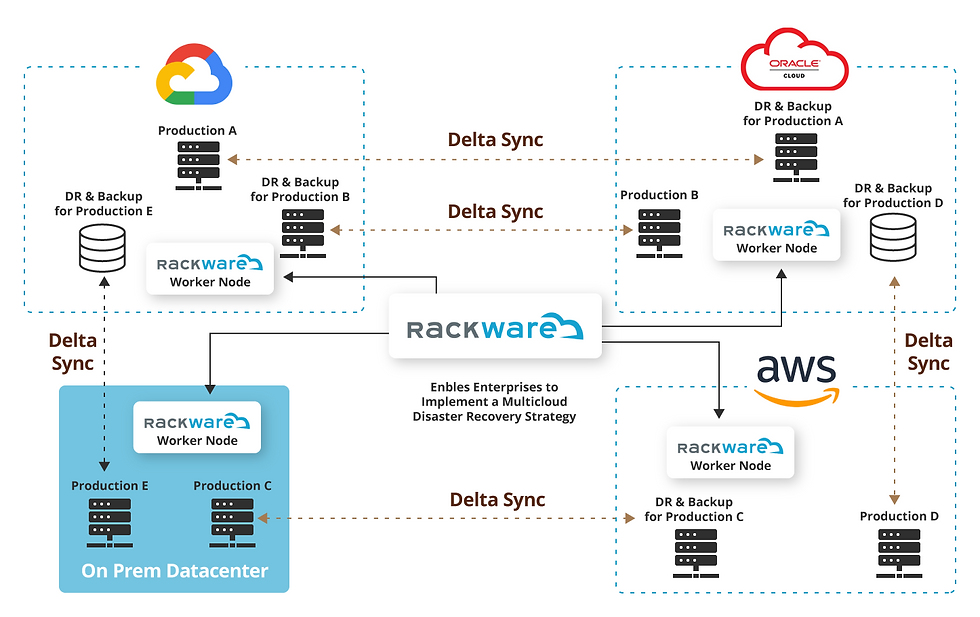
Importantly, resiliency options are built in to RackWare solution. RackWare includes integrated disaster recovery capabilities that are independent of VMware. As part of a VMware Exit, organizations can define flexible RPO and RTO policies, test failover without disruption, and protect workloads across cloud‑to‑cloud or cloud‑to‑on‑prem configurations. Migration and DR are no longer separate initiatives, they become part of the same operational framework.
Turning a VMware Exit into a Modernization Strategy
A VMware exit should not be treated as a one‑time escape maneuver. Done correctly, it becomes the foundation for long‑term modernization.
RackWare enables true hybrid and multi‑cloud mobility, allowing workloads to move freely between AWS, Azure, OCI, Google Cloud, IBM Cloud, and on‑premises environments. This flexibility reduces future vendor lock‑in and allows infrastructure decisions to be driven by performance, compliance, or cost requirements rather than platform constraints.
Cost control improves as well. By right‑sizing workloads based on actual utilization and enabling elastic provisioning, organizations can move away from permanently over‑allocated infrastructure. Predictive cost modeling helps teams understand cloud spend before migration, avoiding unpleasant surprises after cutover.
Resilience also evolves. Instead of rebuilding VMware‑centric DR in a new environment, organizations can adopt platform‑agnostic recovery strategies that are easier to test, simpler to operate, and more cost‑effective over time.
How to Get Started
A successful VMware exit begins with visibility. RackWare’s assessment capabilities inventory operating systems, compute resources, storage, applications, and network dependencies, providing a clear picture of the existing environment. This data allows teams to identify high-risk workloads early and design appropriate migration strategies.
From there, workloads are organized into logical migration waves based on dependency mapping and business criticality. This phased approach reduces risk, enables faster early wins, and minimizes disruption to the business.
Before migration begins, RackWare can estimate cloud costs across multiple providers, helping teams select the most cost-effective landing zones. During execution, staged or host-based syncs replicate data efficiently, with delta syncs used to minimize downtime during cutover.
Disaster recovery is then enabled as part of the final architecture, not bolted on afterward. Failover testing, fallback, and ongoing protection are managed through the same platform used for migration, simplifying operations long after the VMware exit is complete.
Operational Readiness for a VMware Exit
Full inventory of servers, applications, and dependencies completed
Workloads grouped into migration waves with clear business ownership
Cloud landing zones selected and cost modeled
Network and identity requirements validated in target environments
Cutover and rollback plans defined per wave
Disaster recovery objectives mapped to post-migration architecture
Final Thought
Exiting VMware is no longer a niche initiative, it is a strategic inflection point. Organizations that treat it purely as a cost‑cutting exercise risk carrying legacy complexity into a new environment. Those that approach it as a modernization catalyst can emerge with a more resilient, flexible, and future‑ready infrastructure.
With RackWare, a VMware exit becomes more than a migration. It becomes a launchpad for what comes next.
Comments